
habits
Never Miss Twice: What Habit Research Actually Says
by David Langley7 min read
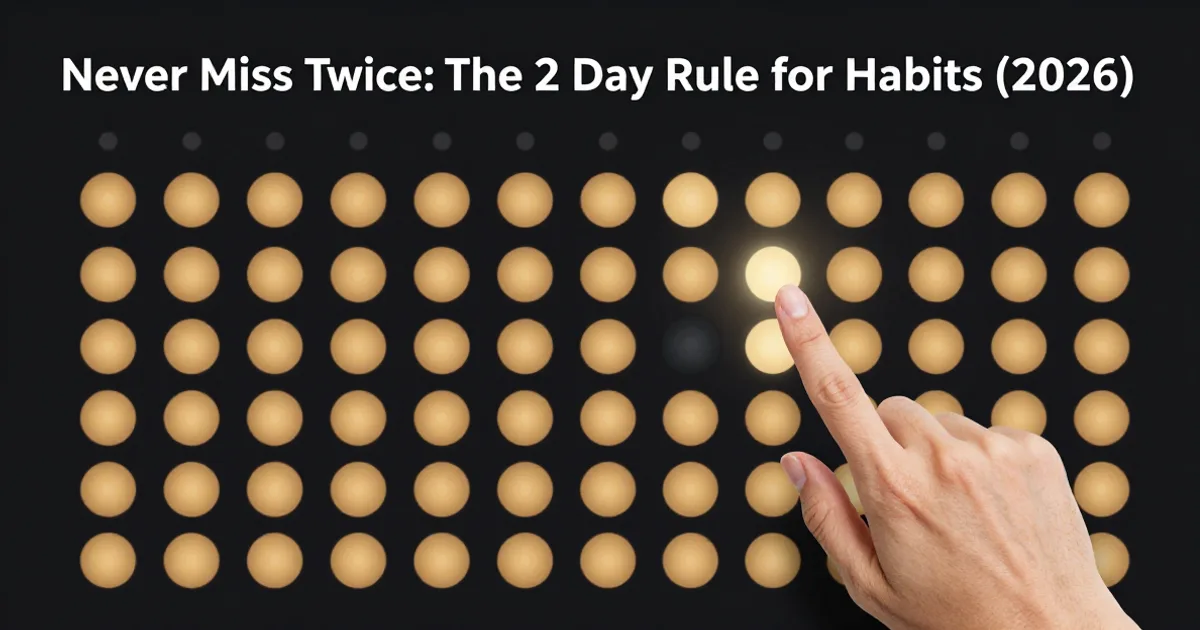

“Never miss twice” gives you a memorable response to a missed habit: return before the interruption grows. You can use that idea if it helps you. Just do not mistake it for a scientific cutoff.
The research often cited beside this rule does not show that two missed days break a habit. It does not establish a 24-hour recovery deadline, a 48-hour danger point, or one protocol that everyone should follow. The rule remains a personal heuristic.
The answer in one table
| Question | Evidence supports | Evidence does not establish |
|---|---|---|
| Can one miss erase the habit process? | The cited Lally study reported that one missed opportunity did not materially change its modeled process. | A guarantee for every person, behavior, or context. |
| Does the second miss break a habit? | No tested two-miss cutoff appears in the cited study. | A 48-hour danger point or universal reset rule. |
| Should you return quickly? | You may use a quick return as a personal planning preference. | A medical, psychological, or research-mandated deadline. |
| Can you shrink the behavior after a miss? | You can choose a smaller version when it still serves your purpose. | One minimum dose that works for every habit. |
The distinction matters because a useful reminder can survive without invented science. Keep the prompt if it helps you act. Drop the deadline if it makes you ignore illness, travel, recovery, safety, or the schedule the behavior actually requires.
What the Lally study actually found
Phillippa Lally and her colleagues studied how people developed everyday behaviors in a stable context. Participants chose an eating, drinking, or activity behavior and reported whether they performed it over 12 weeks. The researchers modeled how automaticity changed with repetition.
According to the Lally et al. paper, one missed opportunity did not materially alter the habit-formation process in its data. That finding pushes back against perfectionism: one omission did not erase the repetitions that came before it.
Read the claim at its actual size. The study did not randomly assign people to miss one day, two days, or longer gaps. It did not compare a 24-hour interval with a 48-hour interval. It did not conclude that the second consecutive miss ends a habit.
A later randomized trial published by University College London reports that routine-based and time-based cue planning can both support habit formation when participants repeat the behavior. It does not establish a two-miss cutoff either. We use it to reinforce the role of repeated cue-linked behavior, not to invent a recovery deadline.
How we read the study
We checked the question against the paper's design before we used its conclusion:
- Population: people chose one everyday eating, drinking, or activity behavior.
- Observation: participants reported performance and automaticity across 12 weeks.
- Analysis: the researchers modeled automaticity as repetition continued.
- Relevant finding: the paper discusses one missed opportunity in its observed data.
- Boundary: the design did not test a randomized one-miss-versus-two-miss rule.
This audit prevents a common leap: “one miss did not materially change this model” does not mean “a second miss destroys every habit.”
Where the “never miss twice” idea fits
According to James Clear's get-back-on-track essay, “never miss twice” can act as a planning shortcut after one omission. That advice can work when you decide in advance to look for the next reasonable opportunity. It remains advice, not a tested two-day law.
That makes the rule easy to remember. It does not turn the rule into a law of behavior.
Your habit may not run on a daily schedule. Your next reasonable opportunity may arrive in an hour, next week, after a trip, or after you recover from an illness. A rigid two-day frame can make a flexible routine look broken when nothing useful has broken.
However, dropping the rigid cutoff does not mean ignoring repeated misses. A pattern can reveal that the timing, context, effort, or purpose no longer fits. Inspect the mismatch instead of letting a slogan decide what happened.
A flexible way to respond after a miss
You do not need an emergency timer or a six-step recovery formula. You can make a smaller, more honest plan.
Name what happened without turning it into a verdict
Write the practical reason if you know it: your schedule changed, you forgot, you felt unwell, or you chose something else. “I missed this opportunity” describes an event. “I always fail” invents a permanent identity from one event.
You do not need to force an explanation when you do not have one. Record what you know and leave the rest uncertain.
Choose the next reasonable opportunity
Look at the behavior and your circumstances. If you can safely repeat it at the next planned time, do that. If the original plan no longer fits, choose another time or context. The useful question is not “Can I beat a 24-hour clock?” It is “When can I reasonably do this again?”
Adjust the size only when the change helps
You may choose a smaller version after a miss, but no study gives everyone the same minimum dose. A shorter session can reduce friction for some behaviors. For other behaviors, a token version may feel meaningless or may not be safe.
Decide what counts before you need the exception. Keep the definition tied to the behavior you actually want to repeat.
Change the plan when misses repeat
Repeated misses can tell you that the timing, location, difficulty, or behavior itself does not fit your life. Inspect the pattern instead of defending the streak.
You can move the behavior, reduce its frequency, add a reminder, ask for support, or stop pursuing it. Stopping an unsuitable plan does not prove that you lack discipline. It shows that you revised a plan with new information.
Use a one-minute recovery record
Fill one row after a miss:
| Planned opportunity | What changed | Next reasonable opportunity | Plan revision |
|---|---|---|---|
| Date, time, or context | Observable event, not a character judgment | The next time the behavior safely fits | One change to timing, place, size, or support |
Example:
| Planned opportunity | What changed | Next reasonable opportunity | Plan revision |
|---|---|---|---|
| Tuesday walk after work | Meeting ended late and the route was dark | Wednesday lunch break | Put shoes by the door and move the walk to daylight |
The record does not prove why you missed, and it does not grade the week. It gives you one inspectable plan. If the next opportunity also fails, add another row and compare the setup.
Choose among return, revise, pause, and stop
- Return when the original behavior still fits and the next opportunity is safe.
- Revise when the timing, location, size, or support caused friction you can change.
- Pause when illness, injury, travel, caregiving, treatment, or another constraint needs priority.
- Stop when the habit no longer serves your purpose or conflicts with professional guidance.
No streak rule can make that decision for you. A training plan, medication routine, recovery protocol, or safety-sensitive behavior may require qualified guidance rather than a motivational heuristic.
Do not use the rule against your health or safety
No habit slogan should pressure you to exercise through an injury, ignore illness, break medical guidance, or perform an unsafe substitute. Rest can be the correct choice. If a clinician has given you instructions, follow those instructions rather than a generic consistency rule.
The same boundary applies to behaviors involving food, medication, substance use, or mental health. A short article cannot prescribe a safe recovery plan for those situations. Ask a qualified professional when the decision carries health risk.
Track the record without worshipping the streak
A streak answers one narrow question: how many scheduled repetitions happened without a recorded gap? It does not measure the quality of the behavior, what you learned, or whether the plan still serves you.
Keep the wider record. A missed entry sits alongside every entry you made before and after it. You can review the pattern without pretending that one gap erased your history or that a second gap crossed an invisible scientific line.
One Percent turns the year into a 365-dot view. One Percent records a short daily highlight and lowlight. One Percent shows daily notes and mood over time. You decide what your habit means.
Questions people ask
Does research prove the never-miss-twice rule?
No. The Lally study supports a narrower statement: one omitted opportunity did not materially affect the habit-formation process in that study. It did not test or validate a two-day cutoff.
Do two missed days break a habit?
The research cited here does not establish that claim. A longer interruption may make a routine harder to resume, but no universal number marks the moment a habit becomes broken.
Should I return the next day?
Return at the next reasonable opportunity if the behavior still fits and you can perform it safely. “Tomorrow” may work for a daily routine, but it is not a scientific deadline.
Should I make the habit smaller after a miss?
You can, if a smaller version still matches your purpose and reduces friction. Treat it as a personal design choice, not a research-mandated recovery dose.
What if I keep missing?
Review the timing, context, difficulty, frequency, and purpose. Change the plan or stop it when it no longer fits. A repeated mismatch gives you information; it does not issue a character verdict.
Keep the useful part and drop the invented cutoff
“Never miss twice” can remind you to return. Keep that reminder if it helps. Drop the claims that science found a two-day boundary, a 48-hour danger point, or an exact recovery protocol. The evidence does not support them.
If you want to inspect a longer pattern, open the One Percent habit guides, run the mid-year review, or use the denominator check before you summarize a week from its worst day. One Percent gives you a daily record; you decide what the record means.
The app behind the dots
One Percent.
One Percent turns the year into a 365-dot view. One Percent records a short daily highlight and lowlight. One Percent shows daily notes and mood over time. One Percent provides iPhone widgets.