
habits
Use Habit Stacking to Attach a New Action to Your Day
by One Percent Editorial Team9 min read
Habit stacking attaches one new action to a habit you already perform, and you write it as a single sentence: After [current habit], I will [new habit]. James Clear states the formula as "After/Before [CURRENT HABIT], I will [NEW HABIT]" on his habit stacking page, and he credits BJ Fogg's Tiny Habits program for the underlying method: Fogg "uses the term anchoring to describe this approach because your old habit acts as an 'anchor' that keeps the new one in place."
Most people assume the formula is the hard part. The hard part comes after: which anchor you pick out of the routine you already keep, how small you cut the new action, and what you change when the anchor habit itself slips.
The three parts you actually write
| Part | What you write | Example |
|---|---|---|
| Anchor | A habit you already do, at one identifiable moment | After I close my laptop for lunch |
| New action | One action you can finish in about a minute | I will write one line about this morning |
| Frequency match | Anchor and action happen the same number of times | Daily anchor, daily action |
Fill those three rows and you have a stack. Leave the anchor vague and you have a wish with better grammar.
Write the sentence before you change anything
Write the sentence with a real anchor in it: "After I brush my teeth at night, I will lay out tomorrow's clothes." You now know the moment, the action, and the order. The word before works the same way when the action belongs earlier: "Before I open my laptop, I will fill my water bottle."
Credit runs in two directions here, and the sources disagree slightly. Clear thanks "SJ Scott for inspiring me to use the word 'habit stacking' from his book by that name" and gives BJ Fogg credit for the method, while Cleveland Clinic's explainer reports that "author James Clear coined it in his bestselling book Atomic Habits." Either way, the method predates the phrase, and nobody involved sells it as a rule of nature.
Why a routine you already keep makes a workable cue
A habit is a response your context triggers, not a decision you win every day. The open-access review Making health habitual: the psychology of 'habit-formation' and general practice, published by Benjamin Gardner, Phillippa Lally and Jane Wardle in the British Journal of General Practice in 2012, puts it directly: "mere repetition of a simple action in a consistent context leads, through associative learning, to the action being activated upon subsequent exposure to those contextual cues."
That review also explains why you borrow a routine instead of inventing one. "A cue located within an existing daily routine (for example, 'when I go on my lunch break') provides a convenient and stable starting point," the authors write. Your morning coffee already happens without a reminder, at roughly the same time. A stack rents that stability instead of building it.
Two numbers from the same review keep your expectations honest. Automaticity "plateaued on average around 66 days after the first daily performance, although there was considerable variation across participants and behaviours." And the famous 21-day figure has no habit research behind it at all: the review traces the myth to "anecdotal evidence of patients who had received plastic surgery treatment and typically adjusted psychologically to their new appearance within 21 days." Adjusting to a face in the mirror tells you nothing about a stacked action. For the fuller timeline picture, read how long it takes to build a habit.
Build the stack in four steps
1. List the anchors you already hit
List the moments you reach every day without deciding to: you wake, you drink the first coffee, you brush your teeth, you close the laptop for lunch, you get into bed. Cleveland Clinic asks the same opening question through psychologist Lauren Alexander, PhD: "What do you do every day, rain or shine, to the point that it's automatic?"
Mark the anchors that survive a bad week. An anchor that depends on a good mood, a quiet office, or an early alarm is a preference, not an anchor.
2. Cut the new action until you can finish it
Pick one action and shrink it until it takes about a minute. Clear names the failure directly: "Habits like 'read more' or 'eat better' are worthy causes but far too vague. These goals do not provide instruction on how and when to act." Read more becomes read one page. Eat better becomes add one vegetable. Journal becomes write one line.
A one-minute action gives you a clean yes or no when you look back. A vague action gives you an argument with yourself.
3. Make the cue specific and immediately actionable
Make the cue specific enough that two people reading your sentence would point to the same second of your day. Clear watched his own stack fail on that exact point. His first version read "When I take a break for lunch, I will do ten push-ups," and he reports the result plainly: "soon, I realized the trigger was unclear. Would I do my push-ups before I ate lunch? After I ate lunch? Where would I do them?" His rewrite fixed the moment and the place: "When I close my laptop for lunch, I will do ten push-ups next to my desk."
4. Match the frequency
Match the frequency of the anchor to the frequency you want from the action. "Your cue should also have the same frequency as your desired habit," Clear writes. "If you want to do a habit every day, but you stack it on top of a habit that only happens on Mondays, that's not a good choice."
Count both before you commit. Two different numbers mean you picked the wrong anchor, not that you lack discipline.
Copy one of these stacks
Copy one of these stacks as written, or keep the anchor and swap in your own action. Each row pairs a moment most people already hit with something you can finish in about a minute.
| Anchor you already do | The sentence you write | Roughly how long |
|---|---|---|
| Pour the first coffee | After I pour my coffee, I will write one line about yesterday | 30 seconds |
| Brush your teeth at night | After I brush my teeth, I will lay out tomorrow's clothes | 1 minute |
| Close the laptop for lunch | After I close my laptop, I will stand and stretch my back | 1 minute |
| Sit down to dinner | After I sit down to dinner, I will name one good thing from today | 20 seconds |
| Hang up your keys after work | After I hang up my keys, I will fill my water bottle | 30 seconds |
| Get into bed | After I get into bed, I will set tomorrow's single priority | 1 minute |
Each anchor above happens whether or not the day went well, and each ends visibly, so you know when the new action starts.
Fix a stack that keeps failing
A failing stack breaks in one identifiable place. Find your symptom in the left column and change one thing.
| What actually happens | Likely cause | The one change |
|---|---|---|
| You forget completely | The cue names a period, not a moment | Rewrite the anchor as a single visible act |
| You remember and skip it | The action is too big for that moment | Cut it to the smallest version you respect |
| It works some weeks | The anchor and the action run at different frequencies | Move the action to an anchor with the same rhythm |
| The anchor disappeared | You anchored to something optional | Anchor to waking, eating, or going to bed |
| Everything collapsed at once | You stacked three new actions on one cue | Keep one, drop the rest for now |
Change one variable at a time. If you rewrite the cue, shrink the action, and move the time in the same week, you learn nothing about which fix worked.
When the anchor habit itself slips
When the anchor habit itself slips, your stack goes with it, and that is the part definition pages skip. Attach a new action to your morning coffee and the stack disappears the week you quit coffee, travel through three time zones, or start work at 6 a.m. Nothing failed in your character. The rented stability ended.
Two moves handle it. Re-anchor to something that happens anyway, since waking and going to bed survive schedule changes that coffee and commutes do not. Or treat the stack as one season of your life and rebuild it when the routine settles.
After a missed day, resist the urge to grade yourself. Recovery gets its own page in never miss twice, and the limits of streak thinking sit in the don't break the chain method.
What habit stacking will not do
Habit stacking will not hand you discipline, and Cleveland Clinic's explainer sets that boundary better than most enthusiasm on the subject. The method "can work," the page says, "but calling the practice 'easy' is overstating it." It adds that "there's no fool-proof technique for building good habits," and that, "like most self-improvement hacks, habit stacking works well for some people and not for others."
Keep the last line where you can see it. Dr. Alexander "emphasizes that it's important to avoid black-and-white thinking. Consistency is key to developing new behaviors, but forgetting or skipping your habit doesn't mean you've failed."
The method attaches an action to a cue. It does not deliver productivity, better sleep, or any health outcome, and no honest source promises that it will. If a stack touches medication, therapy, food, or an injury, take that decision to the professional who knows your case.
How we checked this page
We checked this page against its sources in four steps, and our editorial review keeps that order on every update:
- Source first. Every quoted line comes from the Gardner, Lally and Wardle review, Clear's page, or Cleveland Clinic's explainer, read in full first.
- Quote only what the page says. Where the sources disagree about who coined the phrase, this article reports both versions.
- Refuse the claims nobody made. No source here promises a mood, sleep, weight, or productivity result, so this page does not either.
- Leave the timeline where the research left it. Around 66 days on average, with considerable variation, and no 21-day rule.
Record the days if you want to see the pattern
Record the days if you want to see the pattern, because memory edits the last three weeks. A record shows which days the action happened and what was going on around them.
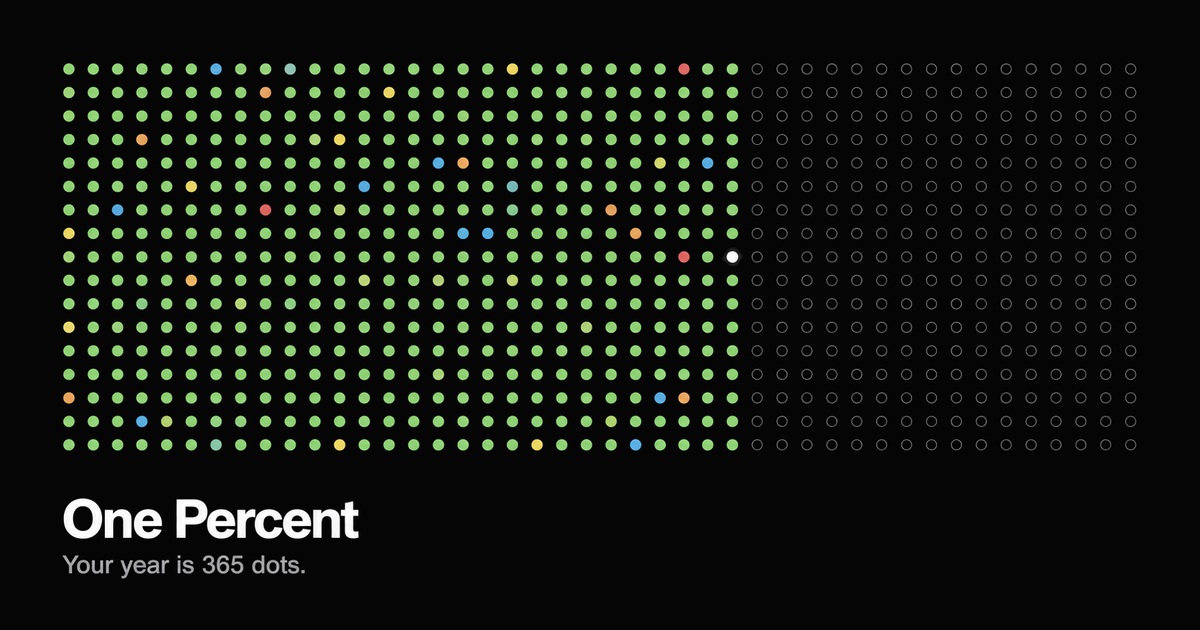
One Percent turns the year into a 365-dot view. One Percent records a short daily highlight and lowlight. One Percent shows daily notes and mood over time, and One Percent provides iPhone widgets so the year stays in sight. It is a year-grid reflection record rather than a multi-habit checklist, so use it to notice patterns, not to score yourself. If that fits how you want to look back, view One Percent on the App Store, or browse the One Percent guides.
FAQ
What is habit stacking in one sentence?
Habit stacking attaches a new action to a habit you already perform consistently, written as: After [current habit], I will [new habit]. The existing habit acts as the cue, so you stop relying on memory or a clock reminder.
Does habit stacking work when you attach a new action to a shaky anchor?
A shaky anchor makes the whole stack shaky, because it passes its instability straight to the new action. Move it to something you do whether the day goes well or badly: waking, eating a meal, getting into bed.
How many habits can you stack onto one anchor?
Stack one action onto one anchor to start. Chains of four actions after one cue look efficient on paper and collapse together the first time you are late. Add a second only after the first runs without effort for weeks.
Is 21 days enough to make a stacked habit automatic?
No, and 21 days never came from habit research. The habit-formation review traces that number to plastic surgery patients adjusting to their appearance. In the research it cites, automaticity plateaued on average around 66 days, with considerable variation between people and behaviors.
What do I do when I miss the stack for a week?
Restart the same stack rather than redesigning your life. Check whether the anchor still happens daily, whether the action still takes a minute, and whether the two match in frequency. Skipping days does not erase your earlier repetitions.
The app behind the dots
One Percent.
One Percent turns the year into a 365-dot view. One Percent records a short daily highlight and lowlight. One Percent shows daily notes and mood over time. One Percent provides iPhone widgets.