
journaling
What Is a Gratitude Journal? A Grounded Starter Guide
by Chloe Harrington9 min read
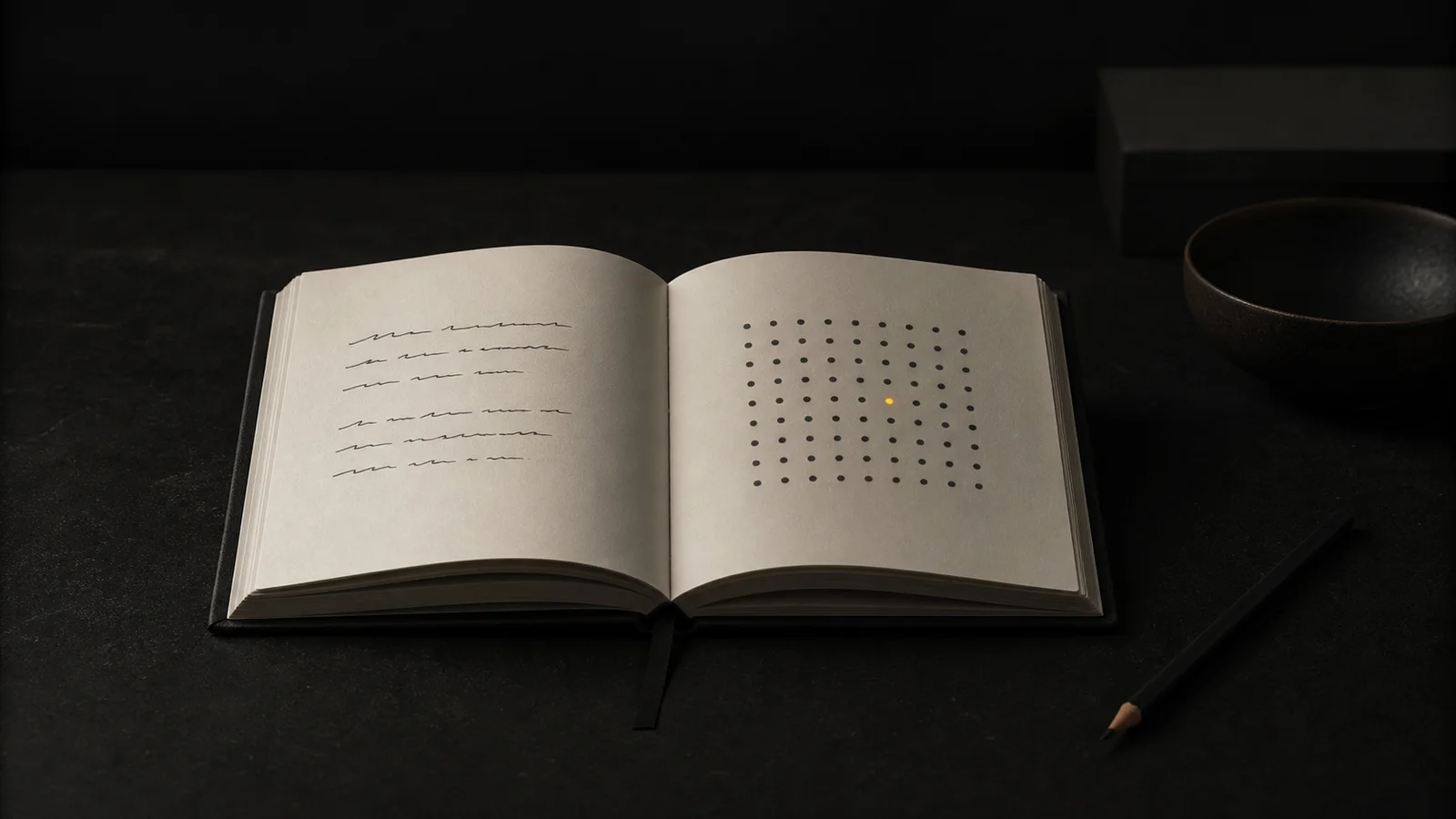
A gratitude journal is a recurring record of specific things you appreciate. You can keep it on paper, in a notes app, as an audio log, or in another format you will actually revisit. You do not need a special notebook, three entries every morning, or a permanently positive mood.
According to Cambridge Dictionary, a gratitude journal records things you feel grateful for at regular intervals. That definition leaves room for a small entry, an ordinary day, and a difficult feeling that stays difficult.
This guide helps you choose a format, write a useful first entry, and resume after a missed day. It also draws a firm line around the method: a gratitude journal can record what you noticed, but it cannot diagnose you, replace care, or guarantee a result.
What a gratitude journal records
A gratitude journal entry works best when it names something specific enough that your future self can recognize it. "My family" may be true, but it tells you little about today. "My sister called while I was walking home and made me laugh about the broken umbrella" preserves a moment.
You can record any of these:
- A person who helped you.
- A small comfort you noticed.
- A task that became easier.
- A place, sound, meal, message, or ordinary detail you want to remember.
- Something difficult and the one thing that supported you beside it.
The last option matters. You do not need to turn a loss, conflict, bad day, or frightening event into a lesson. You can write, "Today was hard. My friend stayed on the phone with me." The appreciation belongs to the support, not to the pain.
What it does not need to become
A gratitude journal does not need to become a happiness score, streak test, forced-positive script, or treatment promise. You can reject any rule that makes the journal harder to use or less honest.
It is not a happiness score
Your gratitude journal is not a happiness score. An entry records what you noticed, but it does not prove how happy, healthy, resilient, or successful you are. A short list cannot measure your mental health, and an empty page cannot measure your character.
It is not a streak test
Regular entries create a richer gratitude journal, but the journal is not a streak test. A missed day does not erase the days you wrote. If a counter makes you protect the number instead of writing honestly, remove the counter or use a format without one.
It is not forced positivity
Gratitude and disappointment can appear in the same journal entry. You can appreciate a quiet room and still dislike what happened before you entered it. A balanced record often preserves more of the day than a list that allows only pleasant details.
It is not a treatment promise
Researchers have tested specific gratitude-journal exercises, but each study asks a narrow question under defined conditions. For example, a study from the Journal of Psychosomatic Research compared two interpersonal gratitude-journal conditions with an active-control journal. That design does not turn every gratitude journal into a treatment or predict what any one reader will experience.
Start with one three-part entry
Start your first gratitude journal entry with this three-part format. Keep it as written or change it after you learn what you want to remember.
- One specific thing: What happened, who was there, and what detail made the moment recognizable?
- Why it mattered today: What did the moment give you, such as help, ease, connection, relief, humor, or a memory?
- What else was true: Name one difficult, neutral, or unfinished part of the day without trying to fix it.
Here is a complete example:
One specific thing: Marco brought me tea before the afternoon call and remembered that I do not take sugar.
Why it mattered today: I had rushed through lunch, so the quiet gesture made me feel looked after.
What else was true: The call still went badly, and I am not ready to decide what to do next.
That entry does not praise the bad call. It records a real gesture and keeps the rest of the day intact.
Copyable gratitude journal template
This copyable gratitude journal template works on paper, in Notes, or in any journal app:
Date:
One specific thing I appreciate:
Why it mattered today:
What else was true:
One detail I want to remember:
If five lines feel heavy, use only the first two. If the word "gratitude" feels too strong on a particular day, replace it with "one thing I noticed" or "one thing that helped."
Seven gratitude journal examples
These gratitude journal examples show different levels of detail. Treat them as starting points, not as lines you need to imitate.
| Day | Specific appreciation | What else was true |
|---|---|---|
| Monday | The bus driver waited while I crossed the street. | I still arrived flustered. |
| Tuesday | My neighbor left two tomatoes at my door. | I forgot to reply until late. |
| Wednesday | I read one page of the book by my bed. | I had little energy. |
| Thursday | The rain cooled the apartment before bed. | The noise kept waking me. |
| Friday | Elena laughed halfway through a voice note. | I miss seeing her. |
| Saturday | I ate lunch outside without checking my phone. | The afternoon felt ordinary. |
| Sunday | I washed the cup I always avoid and cleared the sink. | I left the rest of the kitchen for tomorrow. |
An ordinary entry counts. A mixed entry counts. A one-line entry counts. The record becomes yours because you choose what belongs in it.
Choose paper, digital, audio, or video
Choose your gratitude journal format by friction, privacy, and how you want to revisit the entry. No format wins for everyone.
| Format | Useful when | Trade-off to check |
|---|---|---|
| Paper notebook | You want a separate physical ritual and like handwriting. | You cannot search it, and you need to store it where you feel comfortable. |
| Notes app | You want fast text entry on a device you already use. | Work notes and errands may crowd the same space. |
| Dedicated journal app | You want a purpose-built archive or prompts. | Check its privacy terms, export options, price, and pressure features before you commit. |
| Audio log | Speaking feels easier than typing. | Scanning old entries takes more time unless you label them clearly. |
| Video log | Expression and voice matter to the memory. | Files can be large, and you may not want your face in the record every day. |
Ask yourself three questions before choosing:
- Can I use this on a low-energy day?
- Can I find an old entry when I want it?
- Do I understand who can access, store, or export the record?
Your answers matter more than the number of prompts or features.
Use the missed-day reset rule
Use this gratitude journal reset rule when you miss a day: write the next entry for the day you are in. Do not apologize to the notebook. Do not invent details you cannot remember. Do not force two entries into tomorrow to protect a streak.
Use this reset line if you need one:
I did not write yesterday. Today I noticed: __________.
You can reconstruct a missed day when you genuinely want to preserve a known event. Label it as a later note so you do not confuse memory with a same-day record.
Review the journal without grading yourself
Review your gratitude journal for recurring details, not for a score. You might notice the same person, place, time of day, or small source of support. You might also notice long gaps. Neither observation needs a dramatic conclusion.
Try this short review:
- Which entry do I remember most clearly?
- Which details appeared more than once?
- Which format or prompt felt easiest to use?
- What should I remove from the process next month?
The last question keeps the ritual small. If a five-part prompt became homework, reduce it to one line. If daily writing felt artificial, choose a schedule that matches your actual use.
Keep gratitude separate from mood tracking and habit tracking
Keep a gratitude journal separate from mood tracking and habit tracking by naming the question each record answers. A gratitude journal asks what you appreciated. A mood record asks how you felt. A habit tracker asks whether you did a named behavior. One page can include all three, but the questions remain different.
If you want to record feelings without turning them into gratitude, read how to track your mood. If you want the smallest possible writing habit, use the one-line-a-day journaling method. If you are choosing among paper marks, checkboxes, and a year view, compare which habit tracker fits what you need to see.
Those pages own the deeper method. This page keeps the gratitude-journal question narrow: what the category means and how you can start without pressure.
Record both sides of the day in One Percent
One Percent is a daily reflection option, not a dedicated gratitude-journal protocol.
One Percent turns the year into a 365-dot view. One Percent records a short daily highlight and lowlight. One Percent shows daily notes and mood over time. One Percent provides iPhone widgets.
That feature set fits a reader who wants to preserve both sides of a day rather than fill a gratitude-only prompt. It does not require you to relabel a lowlight as something positive.
If a balanced year view matches the record you want, open One Percent on the App Store, write today's highlight and lowlight, and let that honest pair occupy one day on your year.
You can also browse the One Percent guides when you want a different reflection method.
FAQ
What is a gratitude journal, and do I need to write every day?
No. Choose a schedule you can use honestly. Daily entries create a denser record, while less frequent entries can still preserve specific moments. Do not turn frequency into a judgment about yourself.
What should I write when I do not feel grateful?
Use a smaller prompt: one thing you noticed, one thing that helped, or one detail you want to remember. You can also skip the entry. You do not owe the page a positive answer.
Can a gratitude journal include negative feelings?
Yes. You can record appreciation and a difficult feeling in the same entry. The three-part starter format includes "what else was true" so the journal does not flatten the day.
Is a gratitude journal the same as a diary?
A diary can record the whole day, while a gratitude journal focuses on specific appreciation. You can combine them, but a gratitude entry does not need a full narrative.
What is the easiest way to start?
Write one specific thing, why it mattered today, and what else was true. Use paper or a tool you already open. Resume with the current day whenever you miss one.
Start with the day you have
Write one recognizable detail from today. Say why it mattered. Leave room for the rest of the day to remain complicated.
That is enough to begin. You can change the format tomorrow because you own the journal, not the other way around.
The app behind the dots
One Percent.
One Percent turns the year into a 365-dot view. One Percent records a short daily highlight and lowlight. One Percent shows daily notes and mood over time. One Percent provides iPhone widgets.