
Save for a trip
Ahead of plan
Done38% $1,150 of $3,000
Days left75 to Feb 9, 2027
Pace you need$24.7 a day, $173 a week
You are $25 ahead of plan, about 1 day. $24.7 a day from today still gets you there on time.
Use the tool. Keep your work.
Set a target, a start and a deadline for up to 3 goals. See a thermometer, the daily pace you need, ahead or behind, and the days left as dots.
Start here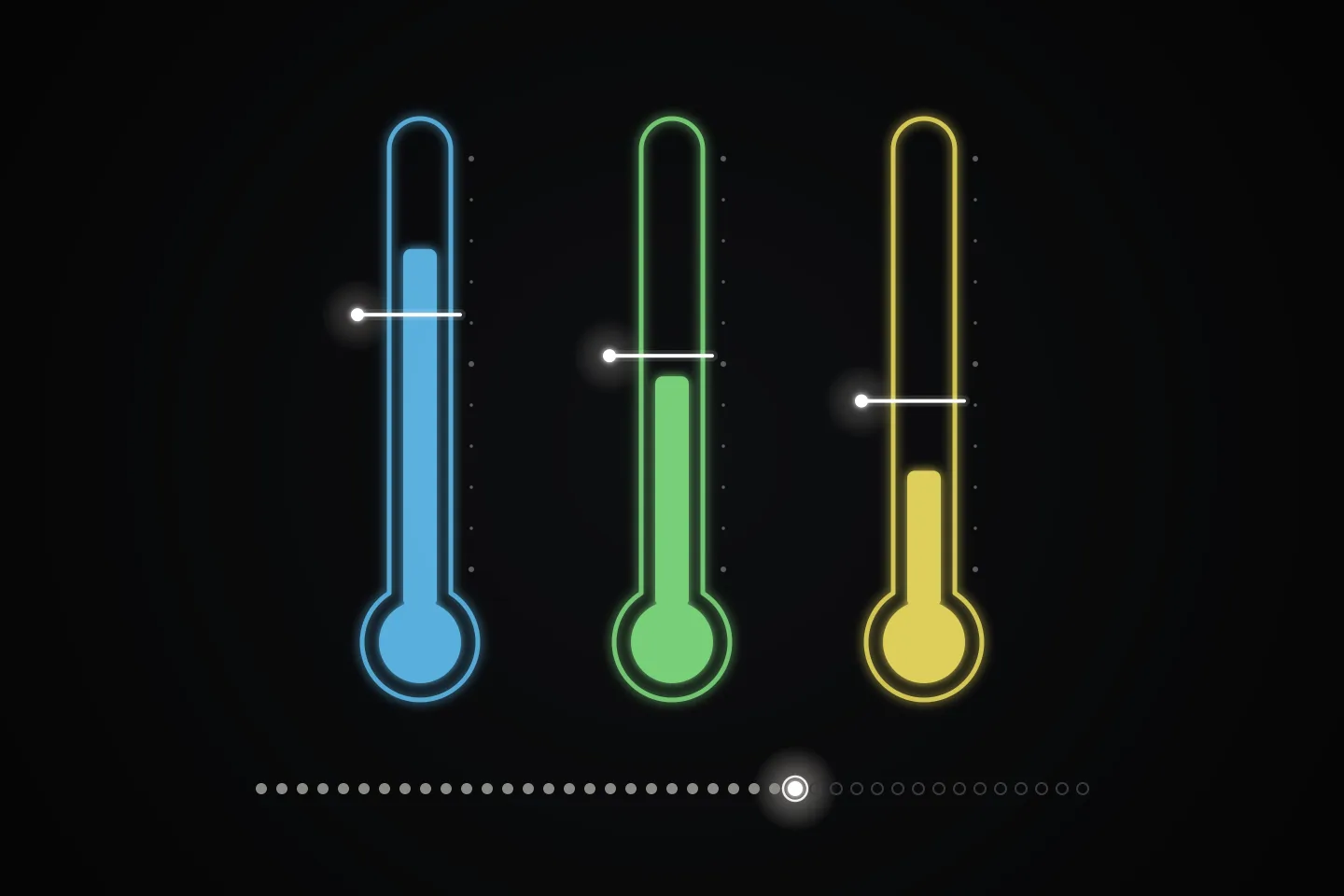
Give each goal a number to hit, the number you start from and a deadline. Then type where you stand today, or add progress as you go.
Ahead of plan
You are $25 ahead of plan, about 1 day. $24.7 a day from today still gets you there on time.
Behind plan
You are 24.9 km behind plan, about 11 days. Raise your pace to 2.72 km a day, 22% more than your plan, or move your deadline to Feb 19, 2027.
My goals
Printed Nov 26, 2026 · getonepercent.app
Save for a trip
$0 to $3,000, Oct 12, 2026 to Feb 9, 2027
Today: $1,150 · Pace you need: $24.7 a day
| Date | Progress | Total |
|---|---|---|
Run 200 km
0 km to 200 km, Oct 17, 2026 to Jan 15, 2027
Today: 64 km · Pace you need: 2.72 km a day
| Date | Progress | Total |
|---|---|---|
The thermometer fills with your progress: how far you have come from your start number toward your target. The tick labeled plan marks where a straight-line plan puts you today. Fill above the tick means you run ahead, fill below it means you run behind.
Pace you need is what is left divided by the days left. Save $3,000 in 120 days and your plan asks for $25 a day. Reach day 45 with $1,150 and you sit $25 ahead of the $1,125 the plan expects, so $24.7 a day from today still lands you on time.
Days left counts from today to your deadline the way a countdown does, so November 20 to November 30 is 10 days. The dots draw every day of the goal: filled dots are behind you and open dots are the days you still have. Windows longer than 400 days switch to one dot per week, and windows longer than about 7 years to one dot per month.
When you fall behind, the line under the numbers gives you two honest choices: the higher daily pace that still hits your deadline, or the date you reach your target if you keep your average pace so far. Goals that count down, like 90 kg to 80 kg, work the same way.
A target you can count beats a wish. Reviewing 35 years of studies, Locke and Latham (2002) found that specific, difficult goals consistently led to higher performance than urging people to do their best. They also found that goals work better with feedback that shows progress toward them, which is the job of the thermometer.
Looking at your numbers is part of the method. Harkin and colleagues (2016) pooled 138 experiments with 19,951 people and found that prompting people to monitor their progress improved goal attainment (d = 0.40). The effect grew when people recorded progress physically or shared it, so print the page or send the link to someone who will ask you about it.
People speed up as a goal gets close. In a cafe reward program, Kivetz, Urminsky and Zheng (2006) found that customers bought coffee more often the nearer they got to a free one. A card of 12 stamps with 2 already filled got completed faster than a plain card of 10, though both needed 10 purchases. Your thermometer shows that distance at a glance.
Deadlines slip because estimates run short. Students in Buehler, Griffin and Ross (1994) predicted they would finish their theses in 33.9 days on average and took 55.5 days, longer than even their worst-case guesses of 48.6 days. Before you set a date, check how long a similar goal took you last time. For daily habits, the printable habit tracker fits better.
Press Print / save PDF. The page holds a thermometer, your numbers and blank log rows for each goal, and the browser leaves out the buttons and the app cards. Choose Letter or A4 above first. Color in the thermometer by hand as you log progress, the way fundraisers fill a poster.
Your goals live in this page's address, after the # sign, so you need no account. Browsers never send that part of an address to a server. Copy the link to save your goals or send them, and remember that anyone with the link can read your numbers.
Write a start number, a target and a deadline, then update where you stand at a fixed time each week. Compare that number with where a straight-line plan puts you today. The tracker above does the math and tells you the daily pace you need.
A goal thermometer is a tube you fill from the bottom as you move toward a target, popular for fundraising and savings. This one also marks where your plan expects you today, so you see ahead or behind in one look.
Subtract where you are today from your target and divide by the days left to your deadline. With $1,850 to go and 75 days left, you need about $24.7 a day, or $173 a week.
Yes. Type the higher number as your start and the lower one as your target. The thermometer, the pace and the status all count down.
It is free and needs no account. Your goals stay in your browser and in the part of the address after the # sign. Anyone you send the link to can read them.
Check the method
Each goal runs in a straight line from your start number on your start date to your target on your deadline. Progress is how far you have moved from start toward target. The plan line is where that straight line puts you today, and ahead or behind is the gap between the two, also shown in days of planned pace. Pace you need is what is left divided by the days from today to your deadline. Your projected date divides what is left by your average daily pace so far. Days count as calendar days, so time zones never shift a count. The method follows research on specific goals and feedback (Locke and Latham, 2002), progress monitoring (Harkin and colleagues, 2016), the goal-gradient effect (Kivetz, Urminsky and Zheng, 2006) and the planning fallacy (Buehler, Griffin and Ross, 1994).
Read the related guide