
habits
Morning Routine: A Checklist That Survives a Bad Night
by Hannah Whitfield12 min read
A good morning routine is a short, fixed sequence you can finish even after a bad night: get up at the same time every day, get bright light into your eyes within the first hour, drink some water, move for a few minutes, and write down the one task that matters most today. Start with a 10-minute version, keep it for a few weeks, and only then grow it to 30 or 60 minutes.
Most routines fail on the mornings you need them, after a late night or a crying baby or a 6 a.m. flight. So everything below has a minimum version. You get the research on morning light, grogginess and habit formation with its limits, three exact routines by the time you have, a free printable checklist, the mistakes that break routines and how to track yours for a year.
Know what a morning routine should include
Five steps carry most of the evidence. Everything else (journaling, cold showers, affirmations) is optional and personal.
| Step | Why it earns a place | What the research shows |
|---|---|---|
| Same wake time, every day | It anchors your body clock | Night owls who moved their wake and sleep times earlier and sought morning light shifted their sleep about 2 hours earlier, with better mood and morning performance (Facer-Childs and colleagues, 2019) |
| Bright light in the first hour | Light sets your body clock each day | Experts recommend at least 250 lux of melanopic light at eye level through the day (Brown and colleagues, 2022) |
| A few minutes of movement | It adds up toward your weekly minimum | Adults need 150 to 300 minutes of moderate activity a week (WHO guidelines, Bull and colleagues, 2020) |
| Breakfast if you are hungry | It changes how active you are more than your metabolism | In a 6-week trial, breakfast eaters burned more energy through activity and ate more, with no change in resting metabolism (Betts and colleagues, 2014) |
| One written priority | It turns a vague morning into a first move | No study tested this step alone. It gives your routine a clear finish and your day a first task |
Consistency matters more than the hour on the clock. A 6:00 alarm you hit every day beats a 5:00 alarm you hit on Tuesdays. Pick a time you can keep on Saturday too, then count back 7 or more hours for your bedtime, the amount the American Academy of Sleep Medicine and the Sleep Research Society recommend for adults (Watson and colleagues, 2015).
Get bright light into your eyes in the first hour
Light resets your internal clock every day. Morning light pulls it earlier, which makes it easier to fall asleep at night and wake up the next morning. Evening light pushes it later.
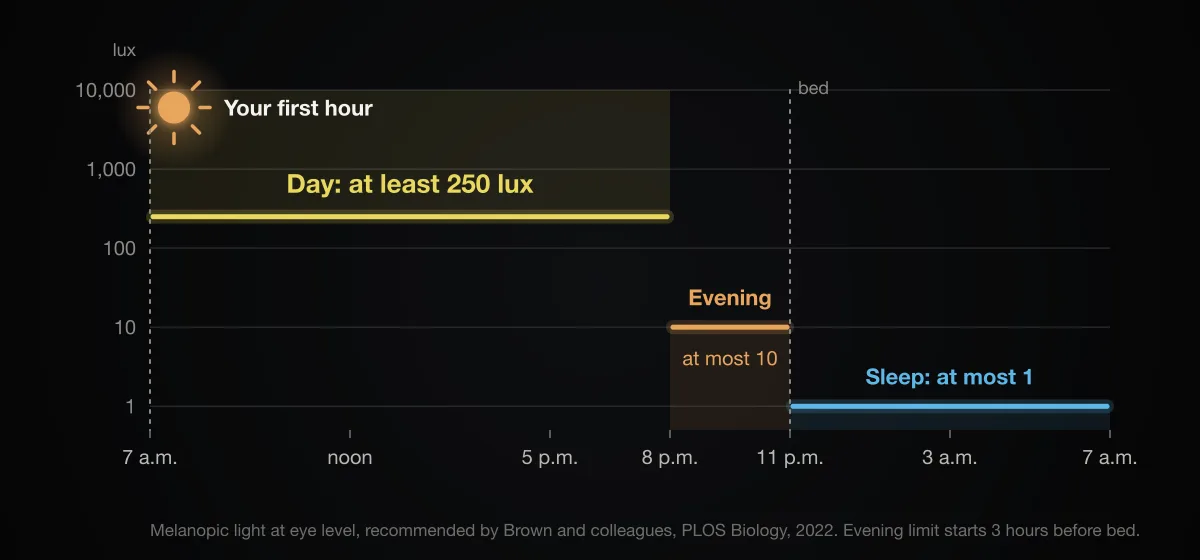
In 2022, a panel of 18 sleep and light researchers put numbers on this (Brown and colleagues, 2022). They measure light as melanopic EDI, the part of light your clock responds to, in lux at eye level:
- Daytime: at least 250 lux.
- Evening: no more than 10 lux, starting at least 3 hours before bed.
- While you sleep: no more than 1 lux.
Indoor light often falls short of the daytime target. In one test the panel cites, offices lit to common standards of 300 to 400 lux on the desk needed about 50% more light to reach 250 lux at eye level. A window or a walk outside does the job far better than a ceiling lamp.
A small camping study shows how strong the effect gets. Eight adults spent a summer week outdoors with only natural light. Their light exposure rose more than fourfold, and their internal clocks moved about 2 hours earlier, with the latest sleepers shifting the most (Wright and colleagues, 2013). Eight people is a tiny sample, so read it as a signal of direction.
A randomized trial with night owls points the same way. Participants moved their wake and sleep times earlier to catch more morning light, fixed their meal times and changed when they had caffeine and exercise. Their sleep and wake times advanced by about 2 hours without losing sleep, and they reported less depression and stress, with faster reaction times and stronger grip in the morning (Facer-Childs and colleagues, 2019).
What to do with this:
- Open the blinds as soon as you get up.
- Drink your water by the brightest window, or step outside for 2 minutes.
- On a 30 or 60-minute routine, take your walk outside before you sit down at a screen.
- Never look straight at the sun. Daylight around you does the work.
Expect grogginess for the first 15 to 30 minutes
The fog you feel after the alarm has a name: sleep inertia. Studies typically find that your thinking returns to its pre-sleep level within 30 minutes of waking, sometimes within 15, while your sense of alertness can keep improving for up to 2 hours (Hilditch and McHill, 2019). The same review found the fog runs heavier after short sleep and lasts longer for late chronotypes.
That has two practical consequences for your routine.
Decide everything the night before. In the first 15 to 30 minutes, run steps that need no choices: feet on the floor, blinds open, water, shoes. Put the glass by the sink and the shoes by the door before bed. Save your priority list for minute 20 or later, when your head clears.
Stop fighting the snooze button on principle. A 2023 study surveyed 1,732 people and then brought 31 habitual snoozers into a sleep lab. Compared with an abrupt alarm, 30 minutes of snoozing improved or did not change their scores on thinking tests right after rising, cost about 6 minutes of sleep and showed no clear effect on mood or morning sleepiness (Sundelin and colleagues, 2024). If you snooze, set the first alarm earlier on purpose and count the snooze as part of your routine. If you wake up exhausted every day, though, a snooze button only hides a sleep problem.
Pick your routine: 10, 30 or 60 minutes
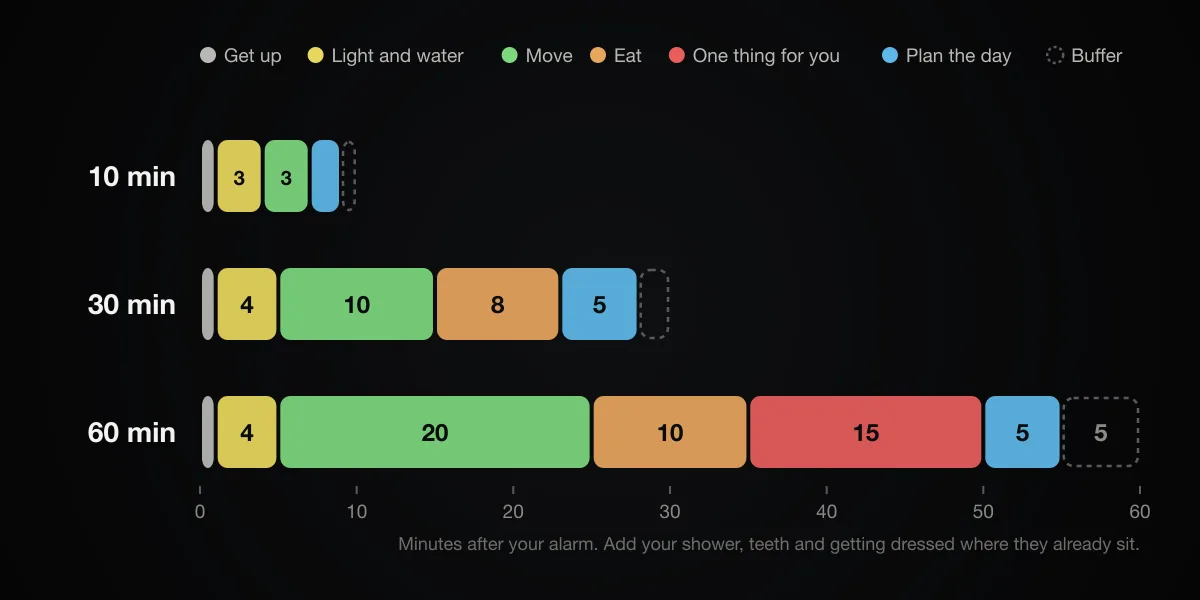
Each routine below covers the routine itself. Add your shower, teeth and getting dressed wherever they already sit in your morning. Every routine follows the same order: up, light and water, movement, then the thinking task once the fog lifts.
Run the 10-minute routine on busy days
- Get up at your set time (1 minute). Feet on the floor before the second alarm.
- Open the blinds and drink a glass of water by the window (3 minutes).
- Move for 3 minutes: 20 squats, a lap of the block or a slow stretch.
- Write your one task for today (2 minutes) on paper or in the free daily planner.
- Keep 1 minute of buffer for the step that runs long.
This version is also your bad-night plan. On any morning that goes wrong, run these 10 minutes and count the day as done.
Run the 30-minute routine most days
- Get up at your set time (1 minute).
- Water and light (4 minutes): a glass of water by the window or on the doorstep.
- Walk outside for 10 minutes. You get light and movement in one step.
- Eat breakfast if you are hungry (8 minutes). Skip it if you are not, and move the minutes to your walk.
- Plan your day (5 minutes): your top 3 tasks with a start time for each.
- Keep 2 minutes of buffer.
Run the 60-minute routine when you have the time
- Get up at your set time (1 minute).
- Water and light (4 minutes).
- Walk, run or train for 20 minutes, outside when you can.
- Eat breakfast (10 minutes).
- Spend 15 minutes on one thing for you: reading, a side project, a language, practice on an instrument.
- Plan your day (5 minutes).
- Keep 5 minutes of buffer.
Here is the movement math. Twenty minutes every morning gives you 140 minutes a week. The WHO asks adults for 150 to 300 minutes of moderate activity a week (Bull and colleagues, 2020), so stretch the walk to 22 minutes, or add one longer weekend walk, and the 60-minute routine covers your minimum by itself.
Before you commit, time your routine once with a phone timer. People guess short: students in one classic study predicted they would finish their theses in 33.9 days on average and took 55.5, longer than even their worst-case guess of 48.6 days (Buehler, Griffin and Ross, 1994). Your morning works the same way.
Download the free printable morning routine checklist (PDF). It holds all three routines with a tick box for each day of the week and blank rows for your own version.
Protect your routine from a bad night
A routine that only works after 8 hours of sleep is a hobby. Build in three protections.
Set a floor. The 10-minute routine is your floor. Your full routine is the goal on a normal day, and the floor is what you do on every other day. You keep the chain going, and you keep the habit.
Move your bedtime, keep your wake time. After a late night, get up at your usual time and run the floor version, then go to bed earlier that evening. Sleeping in by 2 hours moves your morning light later, the opposite of what the campers in the light study got.
Prepare the night before. Lay out clothes, fill the water glass, put your shoes by the door, and write tomorrow's one task on a sticky note. Each item you prepare is one decision you skip while your brain is still waking up.
See a doctor if you sleep 7 or more hours and still wake up exhausted most days, if someone tells you that you snore loudly or stop breathing in your sleep, or if you fall asleep during the day without meaning to. A routine cannot fix a sleep disorder, and those are signs worth checking. If you work night shifts, anchor this routine to your own wake time, whatever the clock says.
Stack each step on the one before
A routine is a chain of habits where each step cues the next. That is why the order stays the same every day.
Habits form through repetition in a stable context. In a 12-week study, 96 volunteers repeated one eating, drinking or activity behavior every day in the same situation, such as after breakfast. The time to reach 95% of their peak automaticity ranged from 18 to 254 days, and missing one opportunity did not materially affect the process (Lally and colleagues, 2010). Expect weeks to months, then, and stop worrying about the one morning you miss. You can read more on that timeline in how long it takes to build a habit.
Once a step turns automatic, it costs you less. In two diary studies where people reported their thoughts every hour, actions done almost daily in a stable context left people free to think about other things and came with less stress than actions done in shifting contexts (Wood, Quinn and Kashy, 2002).
Write your routine as a chain of cues:
- After I turn off the alarm, I put my feet on the floor.
- After I open the blinds, I drink a glass of water by the window.
- After I finish the water, I put on my shoes and walk.
- After I sit down with coffee, I write my one task.
This is habit stacking: you hook each new step onto one you already do. For the steps that keep failing, write an if-then plan, the method behind implementation intentions: "If it rains, then I walk the stairs in my building for 10 minutes."
Fix the 8 mistakes that break morning routines
| Mistake | Fix |
|---|---|
| You copy a 2-hour routine from a founder or an athlete | Start with the 10-minute routine and add one step every 2 to 4 weeks |
| You wake up earlier by cutting sleep | Move your bedtime first and protect 7 or more hours |
| You sleep in 2 or 3 hours on weekends | Keep your weekend wake time close to your weekday one |
| You make choices in the first 15 minutes | Decide clothes, breakfast and your first task the night before |
| You open email and social apps in bed | Charge your phone across the room so the alarm gets you up, and open apps after your walk |
| You drop the whole routine after one bad morning | Run the 10-minute floor version and count the day as done |
| You stay indoors in dim light all morning | Drink your water by a window or step outside for 2 minutes |
| You guess how long the routine takes | Time it once with a timer and size each step from that |
If you miss a day anyway, use the never miss twice rule: the next morning, run at least the floor version.
Track your routine for a year
Tracking keeps the routine honest. A meta-analysis of 138 studies with 19,951 people found that prompting people to monitor their progress helped them reach their goals (d = 0.40), and the effect grew when people recorded progress physically or made it public (Harkin and colleagues, 2016).
Keep the record simple: one tick per morning for the whole routine, with the floor version counting as a tick. Tape the printable checklist to your bathroom mirror, or mark the days on the printable habit tracker. If your routine serves a bigger target, like 200 km of morning walks by spring, put that number and its deadline into the free goal tracker to see the daily pace you need and whether you run ahead or behind.
For a record that lasts the whole year, add your routine as one habit in Habit Tracker: One Percent, on iPhone or Android. Every habit gets its own 365 dots and a streak that forgives one missed day, so a single bad night never resets your count. Tap the habit in your Home Screen widget when you finish your last step.
Get answers to common morning routine questions
How long should a morning routine be?
Start with 10 minutes and grow to 30 or 60 once the short version runs on autopilot. A short routine you finish every day builds the habit faster than a long one you skip.
What time should I wake up?
Pick a time you can keep 7 days a week that leaves you 7 or more hours of sleep. Consistency anchors your body clock more than an early hour does.
Should I exercise in the morning?
Morning is a good slot if it is the slot you keep. A 20-minute walk outside also gives you morning light. What counts for health is your weekly total of 150 to 300 minutes of moderate activity.
Is snoozing bad for you?
In a lab study of habitual snoozers, 30 minutes of snoozing cost about 6 minutes of sleep and did not hurt thinking right after rising. If you need the snooze every day to function, look at your bedtime and your sleep first.
How do I make a morning routine for kids?
Give your child 4 to 6 steps with a picture for each, in the same order every day, and let them tick each one on a printed card. Prepare clothes and bags the night before, and keep the wake time steady on weekends too.
The app behind the dots
One Percent.
One Percent turns the year into a 365-dot view. One Percent records a short daily highlight and lowlight. One Percent shows daily notes and mood over time. One Percent provides iPhone widgets.