
habits
How to Build a Habit That Sticks: 7 Steps From the Research
by Alexander Vaughn12 min read
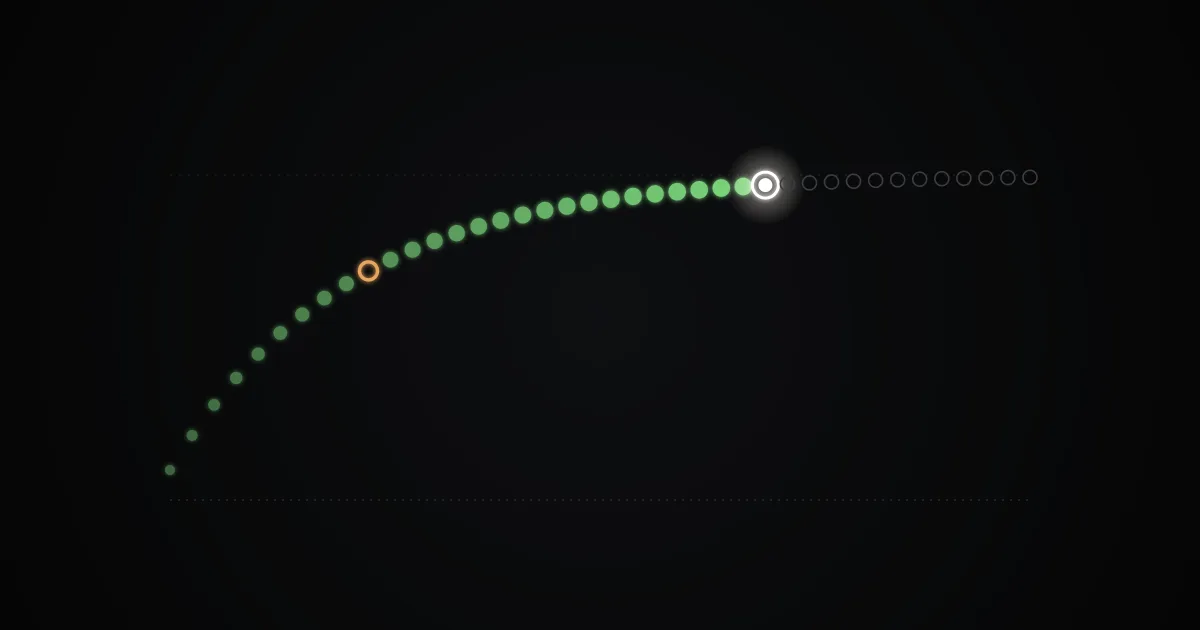
To build a habit that sticks, pick one action small enough to finish on your worst day, tie it to something you already do every day ("after I pour my morning coffee, I write one line"), and repeat it in that same spot until it starts without a decision. Expect about two months for a simple habit and longer for a hard one: people in the best-known study took 18 to 254 days to reach their plateau.
Everything below comes from studies that followed real people building real habits. You get the 7 steps, the timelines by type of habit, a test that tells you when a habit runs on autopilot, the mistakes that stall most attempts and a worked plan you can copy tonight.
Follow the 7 steps in order
| Step | What you do | What the research shows |
|---|---|---|
| 1. Shrink it | Pick one action you can finish in 2 minutes on a bad day | Low complexity predicted faster habit formation in new gym members (Kaushal and Rhodes, 2015) |
| 2. Anchor it | Write "After I [routine], I will [action]" | If-then plans had a medium-to-large effect on reaching goals across 94 tests, d = .65 (Gollwitzer and Sheeran, 2006) |
| 3. Place it after the anchor | Put the new action right after an existing one | Flossing after brushing built a stronger habit than flossing before, still visible 8 months later (Judah and colleagues, 2013) |
| 4. Repeat it in the same context | Same cue, same place, every day | Automaticity grew along a curve that levels off as people repeated a behavior in a consistent context (Lally and colleagues, 2010) |
| 5. Track it where you see it | One tick a day on paper or your phone | Monitoring progress raised goal attainment across 138 studies, d = 0.40 (Harkin and colleagues, 2016) |
| 6. Plan the missed day | Decide now what you do the day after a miss | Missing one opportunity did not materially affect habit formation (Lally and colleagues, 2010) |
| 7. Wait for the plateau | Judge the habit at 2 months, then again at 4 | Peak automaticity came at a median of 59 days in a nutrition habit trial (Keller and colleagues, 2021) |
Shrink the habit until a bad day can't stop it
Start with one action. Pick the version you would still do with a cold, after a late flight or on a night your kid won't sleep: 1 page, 2 minutes of stretching, 10 push-ups against the kitchen counter. You can always do more, and on good days you will.
Size matters because complexity slows the whole process down. Kaushal and Rhodes followed 111 new gym members for 12 weeks and found that consistency, low behavioral complexity, the environment and enjoying the sessions all predicted how habit strength grew. And when Buyalskaya and colleagues traced habits through millions of records, handwashing at work became a habit within weeks while going to the gym took months.
Keep the ambitious version as the upside. "Read 10 pages" is the plan, "read 1 page" is the floor, and a day at the floor still counts.
Anchor the habit to a routine you never skip
A habit is an action your surroundings start for you. You build that link by attaching the new action to a cue you already hit every day, and the most reliable cues are things you never skip: waking up, the first coffee, brushing your teeth, sitting down at your desk, putting the dinner plate in the sink.
Write the plan as one sentence: "After I [existing routine], I will [new action] in [place]." Psychologists call this an implementation intention, and a meta-analysis of 94 independent tests found it had a medium-to-large effect on reaching goals (d = .65). The site's guide to implementation intentions has a fill-in template and 10 worked examples, and habit stacking shows you how to chain several routines.
You can anchor to a clock time instead. In a randomized trial with 192 adults, Keller and colleagues compared plans tied to a daily routine with plans tied to a set time and found both raised automaticity about equally. The behavior that kept getting repeated in response to its cue was what predicted the habit. So pick whichever cue you actually meet every single day.
| Your goal | A cue you already hit | Your one-sentence plan |
|---|---|---|
| Read more | Clearing the dinner table | After I put my plate in the sink, I read 1 page on the couch. |
| Stretch daily | Turning off your alarm | After I turn off my alarm, I stretch my hips for 2 minutes beside the bed. |
| Floss | Brushing your teeth at night | After I brush my teeth at night, I floss one tooth. |
| Drink more water | Making your morning coffee | After I start the coffee machine, I drink one glass of water. |
| Write a journal line | Plugging in your phone at night | After I plug in my phone, I write one line about today. |
Put the new action after the anchor
Order matters more than you'd guess. Judah, Gardner and Aunger asked 50 people to start flossing, half before brushing and half after. The after-brushing group built stronger flossing habits, and 8 months later they still had stronger habits and flossed more often. The anchor works best as the trigger for the new action. Finish the old routine, then start the new one right away.
Repeat it in the same place at the same point in your day
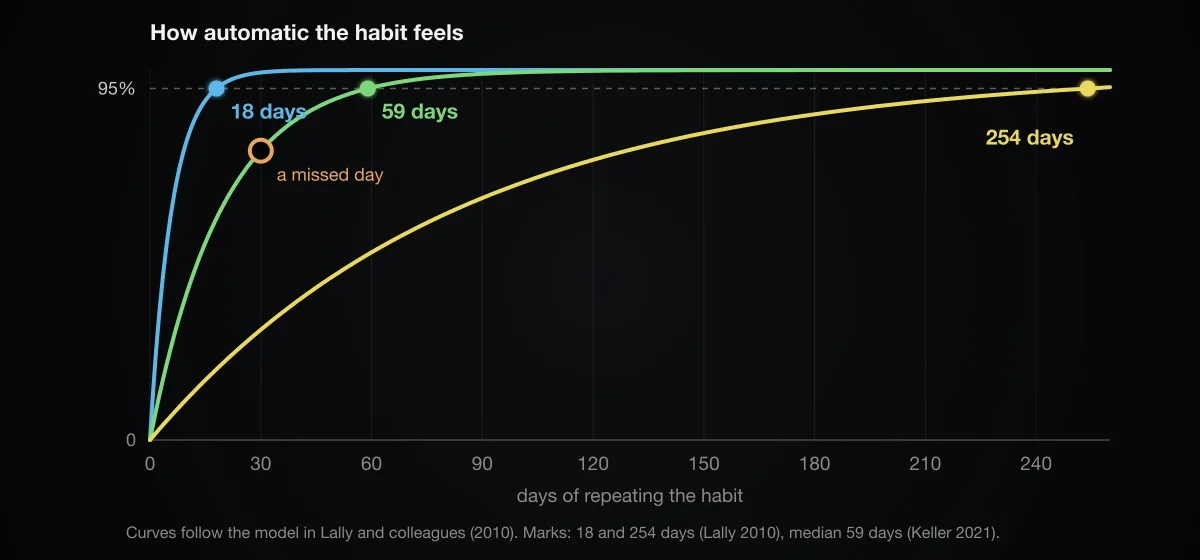
Lally and colleagues asked 96 volunteers to repeat one behavior daily in the same context for 12 weeks, and they rated how automatic it felt each day. Automaticity rose quickly at first and then leveled off toward a plateau, the curve in the chart below. The people who performed the behavior more consistently fit that curve better.
Same place and same point in the day means the cue does the remembering. If you travel, keep the anchor and move the place: the dinner plate goes in the sink at the hotel too.
Track it where you can see it
A habit you can see is a habit you keep. Harkin and colleagues pooled 138 experiments with 19,951 people and found that prompting people to monitor their progress raised goal attainment (d = 0.40). The effect grew when people recorded progress physically or shared it with others.
Keep the record to one tick a day. Tape the printable habit tracker to the spot where the habit happens, or tick it on your phone. Each week, look at the whole grid instead of the last day.
Then pick how you count. A strict streak drops to zero at any miss, which turns one bad Tuesday into a broken record. A forgiving count steps over a single miss and only restarts after two in a row. The never-miss-twice guide shows what the research says about that second miss.
Plan the missed day before it happens
You will miss days. Lally's study answers the scary question directly: missing one opportunity did not materially affect the habit formation process. What hurts is the second and third miss, when a gap turns into a stop.
So decide tonight what the day after a miss looks like: the floor version of the habit, at the usual cue, no catch-up. Three studies back up a plan like this:
- In a megastudy of 61,293 gym members testing 54 different programs, the top performer offered small rewards for returning to the gym after a missed workout (Milkman and colleagues, 2021).
- People preferred goals with an emergency reserve, a skip you can use at a cost, and persisted longer with them than with goals that had none (Sharif and Shu, 2017).
- People who saw a broken streak in their log did less of the behavior afterward than people who saw an intact one, and the drop shrank when they could repair the streak (Silverman and Barasch, 2023).
Read what the never-miss-twice rule can and can't promise, and keep the 24-hour plan for a broken streak for the day you need it.
Give it two months before you judge it
No habit study found a 21-day rule. Here is what studies that measured habit formation actually found:
| Study | Habit | What they found |
|---|---|---|
| Lally and colleagues, 2010 | One daily eating, drinking or activity habit, 96 volunteers | 18 to 254 days to reach 95% of each person's automaticity plateau |
| Keller and colleagues, 2021 | One daily nutrition habit, 192 adults | A median of 59 days to peak automaticity for people who formed the habit |
| Kaushal and Rhodes, 2015 | Exercise, 111 new gym members | At least 4 sessions a week for 6 weeks to establish an exercise habit |
| Buyalskaya and colleagues, 2023 | Gym visits and hospital handwashing, millions of records | Months for the gym habit, weeks for handwashing |
| Fournier and colleagues, 2017 | A daily stretch, 48 students | About 106 days when done after waking, about 154 days before bed |
Read the whole range. In the largest study, handwashing at work settled in weeks while gym visits took months, so give a workout routine the longer horizon. Our guide to how long it takes to build a habit goes deeper on the 21-day myth.
Test whether the habit runs on autopilot
Researchers measure habit strength with a short questionnaire, and you can run it on yourself. Gardner and colleagues picked four statements from the Self-Report Habit Index as the Self-Report Behavioural Automaticity Index (Gardner and colleagues, 2012). Rate each from 1 to 7, where 7 means you strongly agree, with your habit in place of "behaviour X":
- Behaviour X is something I do automatically.
- Behaviour X is something I do without having to consciously remember.
- Behaviour X is something I do without thinking.
- Behaviour X is something I start doing before I realize I'm doing it.
The index has no official pass mark, so watch the trend. Score yourself every two weeks. Automaticity climbs fast early and then flattens, so a score that stops rising near the top of the scale tells you the habit has settled. A score that stalls low tells you to check the cue, the size or the place.
Fix the 6 mistakes that stall a new habit
| Mistake | Fix |
|---|---|
| You start 4 habits on January 1 | Start one. Add the next after the first runs on autopilot. |
| You tie the habit to "the morning" | Tie it to one action you take every morning, like turning off the alarm. |
| You size it for your best day | Size the floor for your worst day and treat more as a bonus. |
| You restart "on Monday" after a miss | Do the floor version at the next cue, even on a Wednesday night. |
| You judge it at day 21 | Judge it at 2 months, then again at 4. |
| You count only a perfect streak | Count your done days and forgive a single miss. |
Copy this plan for tonight
Here is the whole method applied to one habit, reading:
- Floor: 1 page. Plan: 10 pages.
- Cue: "After I put my dinner plate in the sink, I read on the couch."
- Setup: leave the book on the couch arm before dinner.
- Track: one tick each night before bed.
- Missed day: the next evening, read 1 page at the same cue.
- Check-ins: rate the four autopilot statements at day 14, 28, 42 and 56.
After 8 weeks at 10 pages a night, you will have read about 560 pages, from a habit that never asked for more than 2 minutes on a bad night.
Track your new habit in One Percent
Once you write the plan down, add it to Habit Tracker: One Percent on iPhone or Android. Type it in your own words, like "Read 20 pages on weekdays at 7am", and the editor fills itself in. Every habit gets its own 365 dots and a streak that forgives one missed day, so a single bad night never resets your count. Tick it from your Home Screen widget tonight, right after the dinner plate hits the sink.
If you still want to compare trackers first, the habit tracker app comparison checks 7 iPhone apps against their own App Store listings.
Get answers to common habit questions
How long does it take to build a habit?
Expect about two months for a simple daily habit and longer for a hard one. In the best-known study, people took 18 to 254 days to reach 95% of their automaticity plateau, and a 2021 trial found a median of 59 days.
Is it OK to miss a day when building a habit?
Yes. In Lally's 12-week study, missing one opportunity did not materially affect how the habit formed. Do the floor version at your next cue so one miss never becomes two.
What is the easiest way to start a new habit?
Pick one action you can finish in 2 minutes and attach it to something you already do every day, like "after I pour my coffee, I drink a glass of water."
Should I build several habits at once?
Start with one. Add the next habit once the first one starts without a decision, which often takes a couple of months.
Is it better to build a habit in the morning?
Pick the slot you can keep every day. In one small study, a stretch done after waking became automatic in about 106 days and the same stretch before bed in about 154, while a larger trial found routine cues and time cues worked about equally.
Check the sources
- Lally, van Jaarsveld, Potts and Wardle (2010), How are habits formed, European Journal of Social Psychology
- Keller and colleagues (2021), Habit formation following routine-based versus time-based cue planning, British Journal of Health Psychology
- Gollwitzer and Sheeran (2006), Implementation intentions and goal achievement, Advances in Experimental Social Psychology
- Judah, Gardner and Aunger (2013), Forming a flossing habit, British Journal of Health Psychology
- Kaushal and Rhodes (2015), Exercise habit formation in new gym members, Journal of Behavioral Medicine
- Buyalskaya and colleagues (2023), What can machine learning teach us about habit formation?, PNAS
- Fournier and colleagues (2017), Effects of circadian cortisol on the development of a health habit, Health Psychology
- Harkin and colleagues (2016), Does monitoring goal progress promote goal attainment?, Psychological Bulletin
- Milkman and colleagues (2021), Megastudies improve the impact of applied behavioural science, Nature
- Sharif and Shu (2017), The benefits of emergency reserves, Journal of Marketing Research
- Silverman and Barasch (2023), On or off track: how (broken) streaks affect consumer decisions, Journal of Consumer Research
- Gardner, Abraham, Lally and de Bruijn (2012), Towards parsimony in habit measurement, International Journal of Behavioral Nutrition and Physical Activity
The app behind the dots
One Percent.
One Percent turns the year into a 365-dot view. One Percent records a short daily highlight and lowlight. One Percent shows daily notes and mood over time. One Percent provides iPhone widgets.